Q) ANALYSE THE EXTRACT COMMENTING ON THE FOLLOWING:
VISUAL CODES
TECHNICAL & AUDIO CODES
GENRE
______________________________________________________________________________________
A) The extract is the opening scene from the 1999 movie American Pie. In this short, two minute extract we see the main character, Jim, tending to his manly needs when his mother and father awkwardly walk into his room and discover what he is doing in his room.
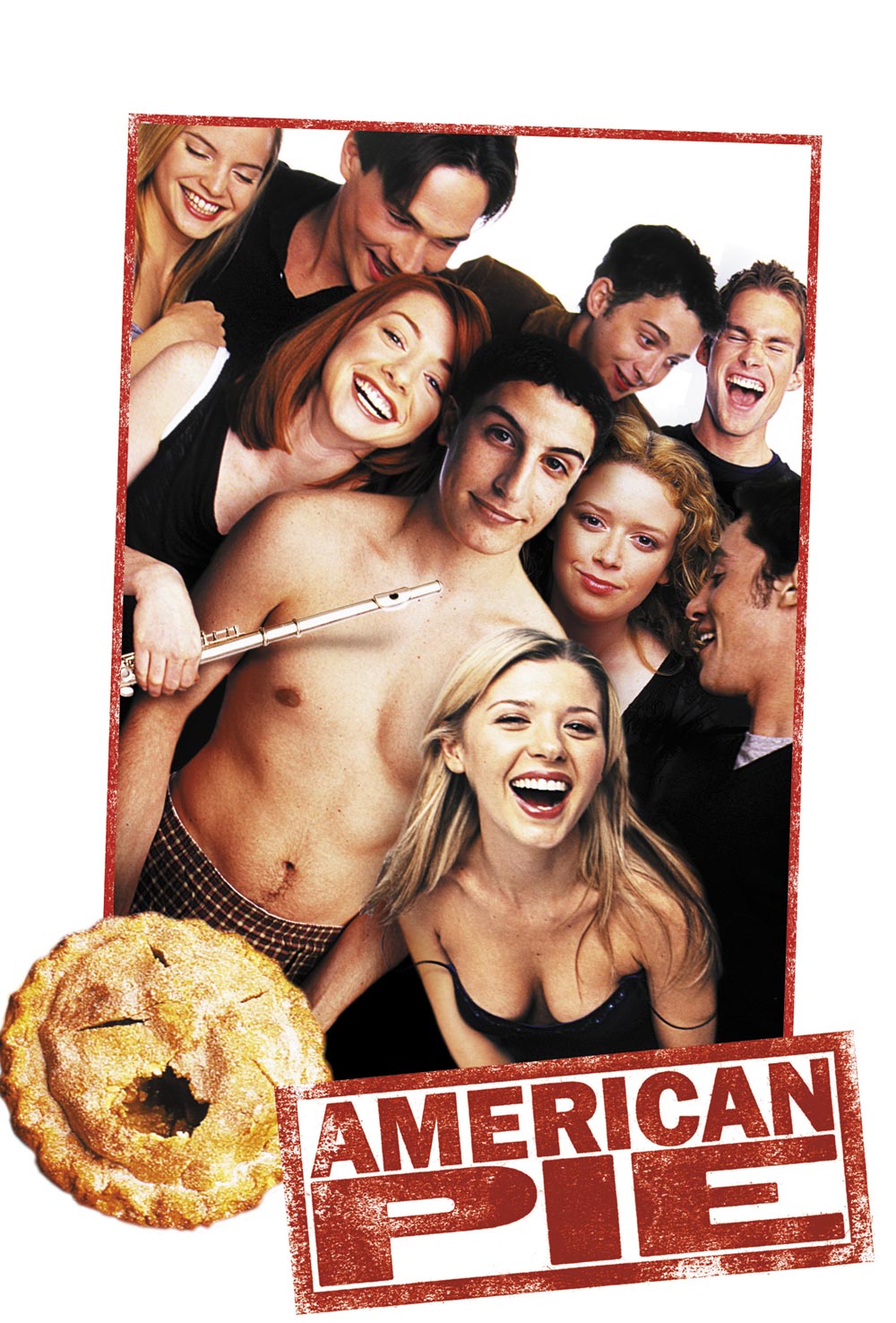 |
| American Pie (1999) Movie Poster |
Halfway through the beginning of the studios credit roll, the audience hears a bass guitar riff which immediately creates a more sexual rather than romantic atmosphere. This tells us that the film's romance is based on vulgar themes rather than the illiterate love scenes you tend to see in films of the romance genre. Therefore, this tells us that there is going to be an element of humour within this film. After a few seconds of the bass riff, moaning can be heard from a female. The tone of her moaning adds to the sexual atmosphere. This combination forms a sound-bridge that flows into the next sequence where there is an establishing shot of a messy bedroom floor.
From the establishing shot, we learn that the bedroom belongs to a male character because on the floor are a pair of blue trainers alongside a black gym bag. The trainers also confirm that the character must be of a younger age (younger than 30). At this point, the beginning of the title credits appear on the screen. As the typography has an informal, white font, this confirms that the film has a relaxed setting and does not have a lot of formal, serious content. A sequence shot of the messy floor shows the audience more clothing that has presumably been taken off and thrown on the floor. The camera rolls from the trainers, up the wooden bed post, across a naked leg and then onto a medium-close up of the lead character's facial expression. The expression depicts pleasure meaning that he is obviously enjoying something that is occurring in the background. When related back to the sound-bridge in the studio credit and the lack of lower body costume, this means that the pleasure must be because of sex. As he is on his own in his bedroom, this confirms that he is not actually participating in intercourse. When the camera reaches the medium-close-up of Jim (the character in this sequence), the title credits stop to allow the acting in the background to be the focal point of the sequence.
There are a series of cuts to and from the TV, the camera ensuring that Jim's eye-line matches the TV screen. The TV is showing a poor, hazy representation of a porn film. This signifies where the location of the sound-bridge originates from and concludes that Jim is in his room gaining self-pleasure from the video cassette. The poor video reception and the TV represents the film's period: it must have been set at a time when video cassettes were still in fashion so the film must have been set during the 1980s or 1990s (at the time of release, present day). From this point, the camera cross-cuts to and from Jim and the TV screen with the camera maintaining a medium-close-up range during cuts of Jim's facial expression to allow the audience to see his reaction to the porn film.
When it comes to diegetic dialogue from the porn film, emphasis has been made on particular phrases to allow fluency in scenes and to add to the sequence's humour. The first notable phrase that the female character says is 'Oh, you're so big'. Whilst maintaining a medium-close-up shot of Jim's facial expression, he lifts up his sock for camera view. An extreme-close up shot of the sock was probably not used because this would have made the scene too cheesy and cheap. There is then a cut to the TV as a male character begins to talk to the female. This annoys Jim and this fury is seen through the facial expression and the annoyed tone in his voice as he speaks bitterly towards the screen when he says, 'Man just shut up!'.
From this point on, the number of cuts increases to manipulate the pace. As an audience member, we feel Jim's anxiety as a long-shot cut of Jim's bedroom shows that an older female character has entered the room. Between this cut and the cut where Jim expresses his anger at the TV, there is a sound-bridge of a female character saying, 'Hey Jimmy'. This is the first time the lead character's name is said and this is a brief introduction of his character to the audience. In this series of cuts, the camera constantly returns to the medium-close up shot of Jim to relate back to his reaction and his anxiety of wanting to cover up his embarrassing act. Even when talking to the other lead character, his eye contact remains focussed on the TV screen. This is evident when he quickly says, 'Yeah sweet dreams, night mom'. This address confirms that the other character in the room is actually his mother. Audience members can relate to this cut because they can understand how humiliating it is for a parent to walk in on something awkward such as an explicit movie.
A few seconds later, the female character on the TV exclaims which triggers an extreme-close up shot of the TV remote. This quickly cuts to an medium shot of Jim's mother's confused facial expression. When Jim tries to explain what's 'wrong with the reception', there is a cross-cut between a medium close up of Jim's eye line matching his mother's and the big close-up of the TV screen when what is occurring on the TV adds to the irony of Jim's explanatory speech. This section cuts back a medium shot of the mother shaking her head suspiciously and turning around to exit his room. Just as she is about to leave the room, there is a exclamation of 'Yes' from the TV and Jim's shocked facial expression which leads to him frantically fidgeting with the TV remote (the remote is displayed with an extreme close-up to show the prop's importance in this scene). There is a long shot of the mother hanging onto the door-knob as she continues to examine the programme with intrigue, throwing herself back slightly when the female character on the TV cries, 'Ride me like a pony'. This adds irony to the situation because Jim originally explains that the programme he's watching is a nature programme and the phrase said by the adult actress refers to sex.
This cuts to a long shot of the bedroom when the mother steps closer towards the TV and Jim's physicality suddenly becomes frantic. The closer the mother is to the TV, the more horrified her facial expression becomes. The diegetic sound from the TV causes the father in the background to enter the room curiously. When he first speaks to his son, a medium close-up of Jim shows that he is even more nervous now that his dad has entered the room. The audience knows that the older male character is his dad because his first line addresses Jim as his son. When the father joins the mother's side, it cuts to a long shot to allow the audience to observe the mother's reaction.
During the father's justification of events, the male character on the TV says, 'Just like my hairy ass'. This causes the father's eye-line to match that of the TV and to ask, 'What was that'. This is another example where the volume of the dialogue on the TV increases to allow the audience to hear what is being said. This adds to the humour of the scene. Then, there is an extreme close-up shot as the father removes the pillow from Jim's crotch to reveal the erect sock. There is a long shot of the bedroom to allow the audience to see the father's stunned facial expression and the mother's turn away in disgust before the camera returns to an extreme-close up of Jim's attempts to cover up the erection with the pillow. There is a medium-close up of Jim's sweaty, embarrassed facial expression when humour is created because of his extremely red face. There is another medium shot then to show the father's panicky tapping of the remote to try and pause the programme. His panicky response adds to the scene's humour as the scene reaches its climax.
The sequence concludes with a medium close up of Jim looking down and away in disgust.
What genre is this film?
From my analysis, I can conclude that this film is definitely a comedy because of the amount of gags that are included in the sequence in an attempt to create humour. However, the tone of the gags is that of a very sexual reference (almost too sexual). The main character's age range is also that of a younger, teenage audience. Therefore, this comedy must be a gross-out comedy because the humour is created through crude material.
